New Book!
AI in Automotive
What is AI doing to our industry?
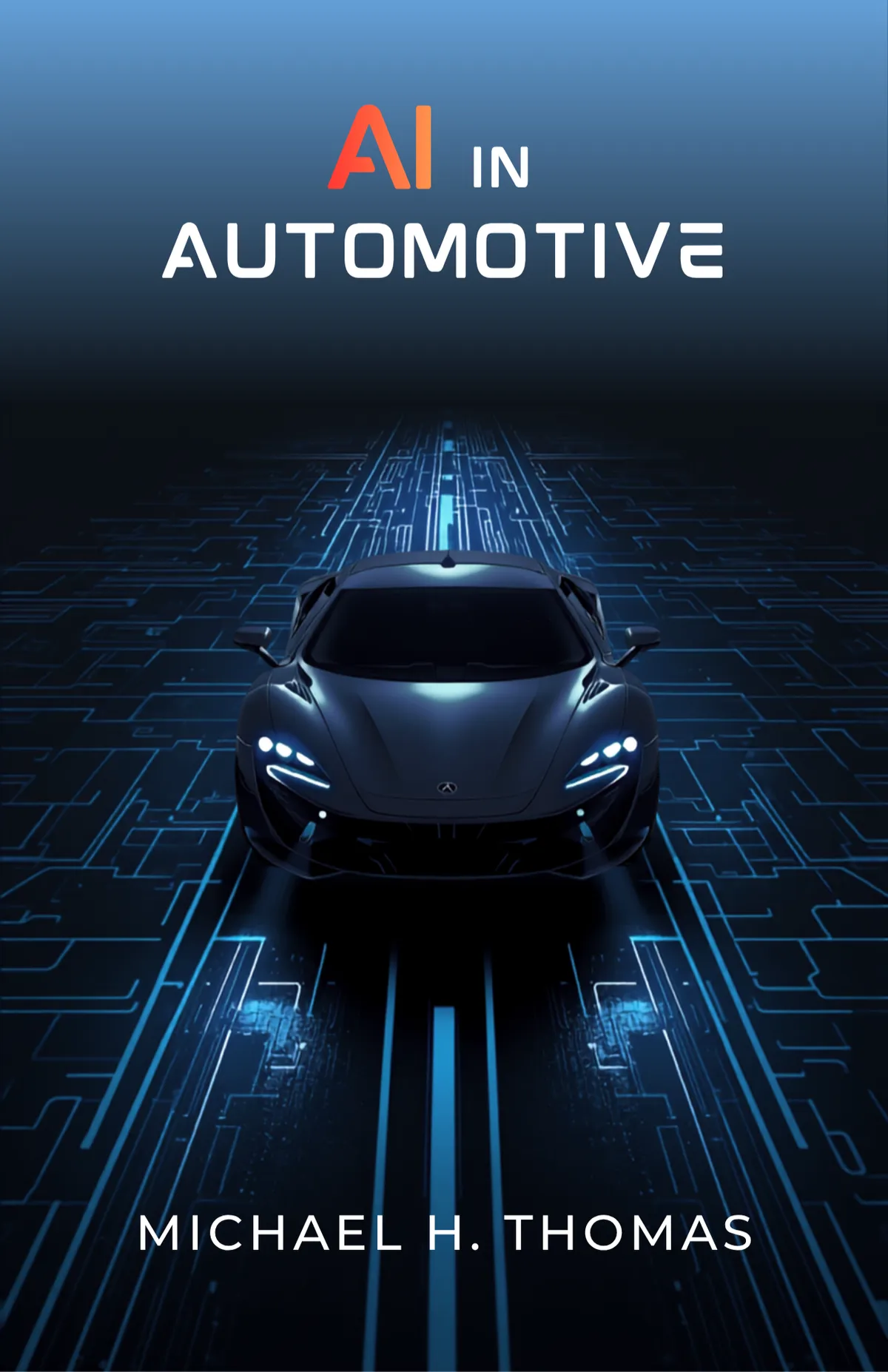
Get the 400-page book!
Free shipping included worldwide!
AI is not coming to the automotive industry; it's already here. AI in Automotive is now critical infrastructure that will define what the modern automotive organisation looks like in 10 years and beyond.
AI in Automotive describes how it's changing competitive positioning and operating economics. From design studios, manufacturing floors, retail environments, OEM agency model, telematics, autonomous driving systems and supply chains to the long tail of aftersales and resale, AI is having a material impact without losing what matters the most; the humans at the centre of it all.
The organisations deploying AI now are seeing economic increases measurable in ways not previously seen:
2.5x more likely to post revenue growth above 10%.
3x more likely to achieve margins above 15.
The window to act is 12 to 24 months.
If you work inside any automotive organisation, whether at an OEM, dealer group, supplier or independent and you need to make capital or technology decisions in the next 12 months, this book contains the framework, use cases, suppliers and results to give you a decision roadmap you can deploy next Monday.
This is the ultimate guide on:
AI in Automotive..
The story
A designer sketches a new idea on Monday.
By Tuesday it is a 360-degree animated model.
That is what happened when GM connected its designers to a generative AI platform called Vizcom, an AI startup. The designer's hand and judgement still drive the originality, inspiration and output, but everything downstream from that point, all the way to the resale of cars years from now, moves at a vastly different speed.
This is the AI story the book tells. We're a long past the get quick rich schemes. We are presenting an AI that is transforming the foundations of the industry you work in.
What this book is and isn't.
A clear-eyed, commercially relevant account of where AI fits in 2026, discipline by discipline and workflow by workflow.
It is not a technical manual, AI evangelism or job-loss narrative.
Written for the 55 million around the world people who work inside this vast and immense industry and need to understand the change happening, right now.
AI is coming from unexpected places.
Each chapter covers the discipline required to bring one car to life; from design, manufacturing, marketing, telematics, motorsport and everything in between. Jump to the work you already do, or if you're like me and have a thirst for knowledge on everything automotive and moto's, read it cover to cover to see where AI is changing it today.
The research base is massive; with the book distilling the core numbers, case studies, experiences and outcomes that your colleagues around the world are seeing. We have searched every corner of the industry across OEMs, Tier 1/2 suppliers, dealerships, third parties to understand how AI is changing the game for them, and eventually you.
We've interviewed key senior operators to understand their view on what work should be preserved for humans and what should be offloaded to AI.
What's inside.
Chapter 2 - The Spark:
Every vehicle programme begins with a small group of people deciding, years before the car reaches the road, what it will be and whether it should exist at all. AI is changing the evidence those decisions rest on, and the leaders who pair its market reading with human imagination are the ones who brands will set the trends in 2030 and beyond.
Chapter 3 - Design & Styling:
AI does not, and cannot, replace the designer. AI blows open the design space the designer can explore with variations on the original concept, moving their role from drawing the vehicle to steering the creative process, allowing OEMs to bring models to market sooner. Physics-aware surrogate models pulls aerodynamic scoring into the styling studio itself, a previously time consuming and strictly sequential process. Electric vehicles particularly benefit, where drag determines range and battery cost.
Chapter 4 - Digital Modelling:
Surface mesh preparation has long consumed up to 60% of simulation project time along with significant compute cost. AI is now automating this bottleneck as simulation stops being a final validation gate and becomes a daily design tool that shapes decisions as they are made.
Chapter 5 - Prototyping:
One prototype can cost $500,000. A vehicle programme may need 100-120 prototypes for validation, testing and assembly calibration. The scheduling process that governs prototype builds and their uses has long lived in spreadsheets and in the heads of a few experienced planners. AI turns that craft into a predictive discipline that cuts the number of prototype vehicles a programme needs and shortens verification from weeks to days, which can save millions per programme.
Chapter 6 - Procurement & Development:
Supplier disruptions, from the post covid semiconductor shortage to major supplier collapses, almost always send warning signals weeks or months ahead. AI now monitors financial, quality and geopolitical signals across thousands of suppliers at once, turning supplier risk from a reactive problem into the predictive advantage that just-in-time manufacturing depends on.
Chapter 7 - Testing & Validation:
Automotive test programmes have long assumed that broad coverage is the safest route to validation, but growing vehicle complexity along with expanding regulatory standards has made that approach over-engineered and under-optimised. AI test prioritisation uses decades of failure data to focus physical testing on the scenarios most likely to expose real faults, as Nissan’s work with Monolith AI showed when it cut bolt-joint physical testing by 17%.
Chapter 8 - Manufacturing & Assembly:
Unplanned assembly line downtime costs $2.3 million an hour. Unscheduled production line stoppages approach $1.4 trillion a year across the Fortune 500. AI predictive maintenance, production scheduling and digital twins together reduce those losses, shorten replanning from up to two days to under thirty minutes, and move much of physical validation into the virtual factory.
Chapter 9 - Inspection & Compliance:
Manual visual inspection has reached the limit of what it can catch, with human inspectors detecting roughly 70 to 85 percent of defects and unable to cover every part. AI computer vision now inspects every part in real time at 95 to 99.8 percent detection accuracy, and it shifts quality control from catching defects to preventing them.
Chapter 10 - Logistics & Distribution:
Automotive logistics disruptions run at $13 billion per year. Therefore, getting the right vehicle to the right dealer, and making sure it arrives undamaged can be the most expensive and least optimised stages of the automotive lifecycle. AI addresses both at once, with forecasting that matches supply to demand weeks or months ahead and computer vision that inspects vehicles in seconds at every handover, flipping a potential source of significant loss into a source of advantage.
Chapter 11 - The Dealership Experience:
Dealerships rarely lose sales for want of leads. They lose them because most enquiries go untouched and the median response takes more than six hours, by which point the buyer has already moved on. AI lead scoring ranks and routes every enquiry in real time, cutting response to under a minute and reactivating dormant CRM records, so sales teams spend more of their time in human to human engagement, as far less on tedious follow-up admin.
Chapter 12 - Digital Marketing & Lead Generation:
AI has moved dealer sales from experiment to commercial infrastructure, with pricing set at VIN level, personalised online showrooms and lower-cost buyer acquisition working as one system. Dealerships that run all three layers gain margin, conversion and audience advantages that manual operators will struggle to match.
Chapter 13 - OEM Agency Model:
Manufacturers from Mercedes-Benz to Volkswagen have moved to sell directly to customers, gaining pricing control and first-party data, but many have found that direct ownership brings a flood of leads they cannot answer. AI conversational engagement is achievable on a national scale, and paired with the agency model, it creates an operating model that solves the large lead flow.
Chapter 14 - Aftersales & Service:
Aftersales is moving from waiting for customers to call toward predicting what each vehicle needs, with telematics data and service history prompting owners before a service interval is missed. The same data sharpens parts stocking and warranty analysis, so one connected infrastructure compounds its returns across the whole service operation.
Chapter 15 - Resale & Remarketing:
Used-vehicle valuation depends on two things: accurate pricing from real-time market signals, and accurate condition data from inspection. AI now delivers both at scale, turning gut-feel appraisals into auditable valuations generated in seconds and condition reports produced in under two minutes, and with it, a reconditioning cycle that is roughly halved.
Chapter 16 - The Connected Car:
The connected vehicle has become a continuous data asset, giving manufacturers the direct line to customer behaviour and vehicle health they lost the moment a car left the showroom. That line is only worth having if it is built on transparent consent, because brands that earn customer trust will own the relationship, and those that do not will find it handled by a software stack they never built
Chapter 17 - Autonomous Vehicles:
Autonomous driving has moved from debate to commercial reality, with robotaxi services already carrying paying passengers in several cities, yet universal full autonomy is still distant. This chapter examines the competing architectural bets behind it, what the rise of robotaxis could mean for personal car ownership, and why you need to commit to a position on autonomy now, rather than react after regulators and competitors have settled it.
Chapter 18 - AI Ethics & Workforce:
AI is forcing a leadership choice about the automotive workforce: the same tools can either free experienced people from the judgement-driven work machines cannot do, or be used to strip out the human layer that makes the technology pay off. The experienced service advisor on the phone about a noise in a customer’s Hilux is not a cost to optimise, and what happens to people like her is a decision leaders are making now.
The book presents consistent data across all chapters that jobs are not being lost purely through AI, and the proponents who are leveraging AI experience an enormous uplift in productivity and time compression over their traditional roles. I did note that this was not a job-loss narrative but the facts speak otherwise.
Chapter 19 - Strategy for the future:
The top 15% of automotive AI adopters are far more likely to post strong growth and margins than laggards, and the window to catch up is closing within the next 12 to 24 months. Seven strategic bets, bound together by an AI-powered executive dashboard and a leadership team that shares ownership of them, give you a practical way to act before that gap becomes permanent.
Chapter 20 - AI in Motorsport:
Motorsport is where the AI-native operating model was first built and stress-tested, from F1 pit walls to endurance racing, and it exists to protect the human experience of going fast. The AI serves the racing, and the racing serves the person at the wheel which the global fan base tune in to witness.
Chapter 21 - The AI-Native Auto business:
In 100 years, AI will be as ubiquitous as electricity, and the AI native OEM is one whose operating model is built around data and intelligence from the start. This chapter projects 10, 50, and 100 years into the future and how your decisions today will determine how your organisation looks then. My central argument is that machines should absorb the mechanical and informational work, leaving people free to do the taste, judgement, ethics, and care that only humans can provide, and where we truly find deep satisfaction in our purpose.
Will this book answer my questions?
You’re hearing about AI every day.
This book tells you what it means for your job; what is happening today, what is coming down the pipe and the tools to make the correct decisions that will protect your role, business and future. If you run any organisation that touches any part of the automotive and motorcycle industries, you have probably asked yourself some version of these questions.
Is my role going to exist in five years?
The book answers this role by role. It shows which parts of each job AI takes over, which parts it makes more valuable, and why the answer is rarely “all of it.” Chapter 18 names the roles most exposed, including parts administrators, BDC agents and sales consultants, and explains why the 28 to 55 percent of each role that AI cannot do is where your future sits. Chapter 17 gives you a method for running a role-by-role exposure audit on your own team.I have lost my job, or I think I might. Where does my experience fit now?
Twenty-five years of industry knowledge is not obsolete. It is the thing AI cannot reproduce. The book describes the Human Power Zone: judgement, taste, craft, empathy, ethical reasoning, leadership and storytelling. Those are the skills that move people into the work the industry is hiring for next. The book shows which parts of automotive are changing fastest and where an experienced person can move with credibility.Everyone around me talks about AI. I don’t understand it well enough to lead.
You do not need to understand how the models are built. The book is written for people who already know this business and want to see how AI changes it. It walks through design, engineering, manufacturing, quality, logistics, retail, aftersales, resale, connected cars, autonomy and workforce, one discipline at a time, with a Monday action at the end of each chapter.Which numbers can I trust, and what are they actually delivering?
The book was built on published deployments, audited results and named sources, not paid for advertisements. You will find the numbers that matter to your function: Volvo cut a full-vehicle CFD run from 24 hours to 6.5 hours, Jaguar Land Rover took daily design evaluations from around 50 to 1,500, and unplanned downtime in a plant costs $2.3 million an hour. Chapter 18 sets out the NTT DATA finding that the top 15 percent of AI adopters are 2.5 times more likely to post double-digit revenue growth, and 3 times more likely to exceed 15 percent margins.How do I bring my team with me without losing them?
Most organisations are not ready for the workforce transition. The book is direct about this, and it gives you a way through: decide, in writing, what AI will and will not change in your operation, reskill deliberately, and make the choice visible from the top. Chapter 18 explains why the leaders who protect their people keep their best talent.Where do I start, and how long do I have?
The evidence points to a window of roughly 12 to 24 months before the gap between leaders and laggards becomes hard to close. The book ends with a practical path: an honest read on where your organisation sits, a small number of bets chosen deliberately, and a written view of the long picture for your operation.Take the free AI Maturity Assessment at www.ai-score.me that our AI consultancy, Tucana AI, built. This assessment gives you an honest read on your company/role and its use of AI. Both the site and the book explains what to do immediately with the result.
What does this book give me that the trade press does not?
Honest scope. It is not a technical manual, not AI evangelism and not a job-loss narrative. It is a clear account of where AI fits in your work, written by someone who has spent more than 25 years inside this industry across three continents, from design studios, wind tunnels, proving grounds, engineering halls to dealer digital marketing and board rooms.The book is the most efficient way to answer all of these questions in one place.
Each chapter gives you the operating picture for a discipline, the evidence behind it, and the first action to take next Monday. Read the chapters that match your role first, and you will have a clearer view of your career, your team and your numbers than most of your peers.
You have stumbled upon the definitive book on the most revolutionary technology and how its being used, today, in your industry.
Please read the following letter...

From:
Michael H. Thomas
Sydney, Australia
Tuesday, 11:32 a.m.
Dear Friend,
I have no idea how you got to this page.
Maybe a colleague sent it to you. Maybe you saw a post about AI in a dealer group, or heard a supplier mention a 3 a.m. call from a plant that had stopped. Or perhaps you typed something vague into a search bar and this was what came back.
It makes no difference, and here is why.
If you work in automotive, in motorcycles, or anywhere in mobility, AI is already changing your job. It may be changing it in ways you cannot yet see from where you sit. This book is the operating picture of where that change has landed in 2026, written for people who already know the business and want to understand what is happening to it.
Let me start with a story, because the book does.
Some years ago I spent the night shift in an aero-acoustic wind tunnel in Detroit, watching one of our body parts being tested on a newly released Dodge Viper (showing my age now :-). An aero-acoustic wind tunnel measures both airflow dynamics across the surface, as well as the noise that is created from that airflow. The challenge is wind tunnels are inherently noisey things, with a huge fan to generate wind speeds up to 200km/h. In order to measure only the airflow noise from the vehicle, the wind circuit has to cancel out the turbine noise at the circuit's turning vanes, a clear demonstration of supreme technical engineering and material usage. The capex on the facility itself is significant, warranting the 24-hour utilisation with every run costing real money.
The work we conducted that night is the work that AI is now compressing. A full-vehicle CFD run that once took 24 hours or more can now be shown in under seven hours on computer. The real advantage here is the time compression to an almost identical result, not withstanding orders of magnitude less in financial cost.
The people I worked with that night, engineers who run tests for Nascar teams, were not replaced by the faster tools. They were freed to analyse results across more virtual test runs, and make recommendations faster on surface changes, decisions the machine cannot make. This pattern runs through the whole book, across all disciplines and domains.
The book is twenty chapters, plus an introduction and a conclusion, covering the full life of a vehicle and a motorcycle: from the first concept brief, through design, engineering, manufacturing, quality, logistics, the showroom, aftersales, resale, the connected car, autonomy, the workforce, and the strategy that ties them together. Around 380 pages, written to be used. Each chapter ends with a section on three things you should do next Monday.
You will learn the published numbers on the benefits of AI, and the evidence that stands behind them. The difference between the leaders and the laggards, and why the gap is widening from an economic point of view. I present seven strategic bets that form one operating model rather than a menu of point solutions. I suggest how to think about your own role, your team, and your career in a changing industry. And what the work is for, which is the question the book keeps returning to.
Read your own job role or function’s chapter and walk into your next meeting with a clear view of where AI is already working, where it is not yet, and which decision is yours to make. Run a short exposure audit on your team and choose one bet worth making in the next two years.
This book will not make decisions for you. I don't tell you which vendor to buy, and it will not pretend every promise is delivered. It would be stupid to promise such things with the pace of change we are currently witnessing. But I've written it honestly, and it is written for you.
Here is what I recommend; read the chapter for your discipline. Then read its Monday section. Then decide whether the operation you run is positioned for the next five years, or whether it is still running on old thinking.
The only prediction I do make is that if you don't take firm decisions today around AI, your role and company will fall into the laggard cohort, a group that you don't want to be in. I say this because the numbers are already starting to come in.
"AI in Automotive" is $47.95 USD, shipping included. Pretty cheap considering the density of data you're getting and a practical roadmap to harnessing the most powerful technology we have ever built.
I think you will find it is the most useful thing you have read about your industry this year. Come and see for yourself.
Warm Regards,
Michael H. Thomas
P.S. If you want to get started, RIGHT NOW, on understanding where your role or company fits with AI, head over to www.ai-score.me and take our free questionaire. It takes about 15mins and will give you an accurate snapshot of where you sit on the AI usage and adoption spectrum. Based on your results, you'll receive customised direction on how to resolve your bottlenecks and weakspots.
P.P.S. The research base that the book sits on is live at www.ai-in-autos.com. We are constantly looking at published data from every corner of the internet, maintaining open dialogue with friendly AI-centric executives
a question has been sitting with you about your job, your team, or what AI means for the business you run, the book is written to answer it. If you're still unsure, email me direct: [email protected]
Who this book is for...
Chief executive officer
Chief Digital Officer
Chief Information officer
chief financial officer
Non-Executive director
chief marketing director
vehicle engineering
design team
plant management
quality assurance team
Assembly engineering
tier 1 executive
OEM marketing
dealer principle
dealership owner
dealership GM
Dealerhip sales
aftersales team
cae Team
motorsport teams
connected vehicle team
ADAS programme team
Human resources
marketing agency's
automotive SEO
dealer CRM provider
automotive media agency
auto photography/video
auto copywriting
automotive SAAS vendor
auto data/analytics
auto system integration
telematics engineering
auto finance/leasing
automotive insurance
used-car remarketing
auto auction houses
vehicle logistics
automotive recruitment
training/certification
automotive consulting
motorcycle accessories
motorsport sponsorship
auto restoration
automotive legal
Want to get in touch?
The book has been written by the same team that runs Tucana AI, an Australian and New Zealand based consultancy that specialises in AI Consulting, Coaching, Assessment and Readiness and AI Custom Development.
COMPANY
CUSTOMER CARE
LEGAL
Copyright 2026. Australia. All Rights Reserved.